
Pinterest works differently from most platforms. People do not scroll to socialize. They search, save, and plan for the future. Because of that, Pinterest engagement signals are not about popularity; they are about usefulness.
This guide explains what Pinterest engagement signals are, why they matter, and how they affect the visibility of Pins over time. It focuses on what is known from official Pinterest documentation and long-term platform behavior. Where details are not publicly confirmed, that uncertainty is stated clearly.
You will also learn how different engagement signals work together, which ones matter most, and how to improve them without chasing myths or shortcuts. The goal is clarity, not hype.
Table of Contents
Key Takeaways (Quick Summary)
- Pinterest engagement signals show how helpful a Pin is to real users.
- The keyword and search intent match decide whether a Pin can appear at all.
- Saves are the strongest signal for long-term visibility.
- Clicks and outbound clicks show interest and action.
- Impressions are a result of distribution, not a cause.
- Consistency supports growth but cannot replace relevance.
Pinterest rewards content that helps people plan, decide, and act. Engagement signals help the platform understand which Pins do that well.
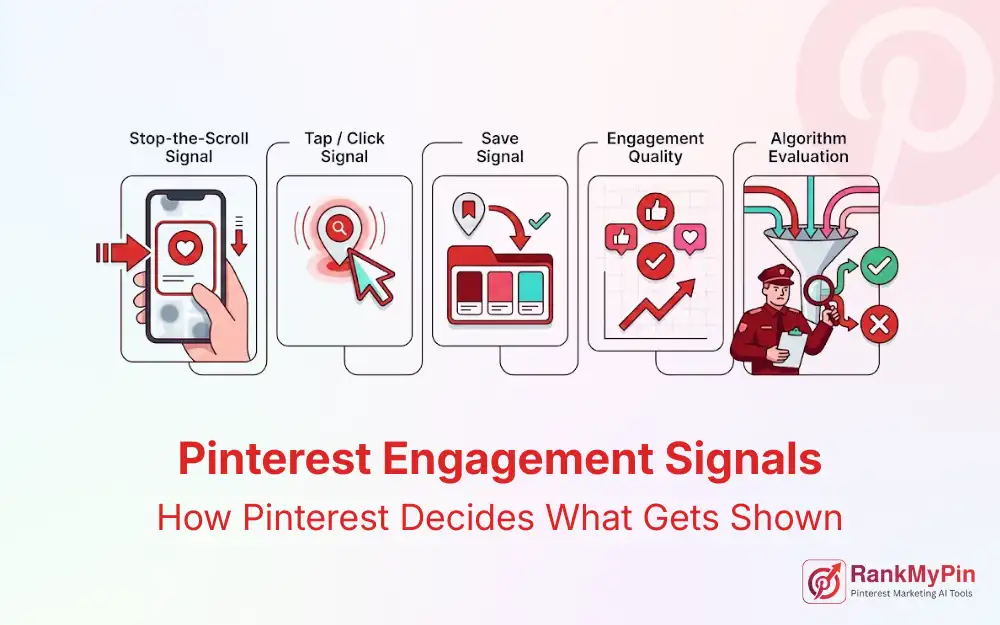
What Are Pinterest Engagement Signals?
Pinterest engagement signals are user actions, such as saves and clicks, that help Pinterest understand whether a Pin is relevant, useful, and worth showing to more people.
When someone saves a Pin, clicks it, or visits the linked page, they are giving feedback. Pinterest uses that feedback to decide whether similar users might also find the Pin helpful.
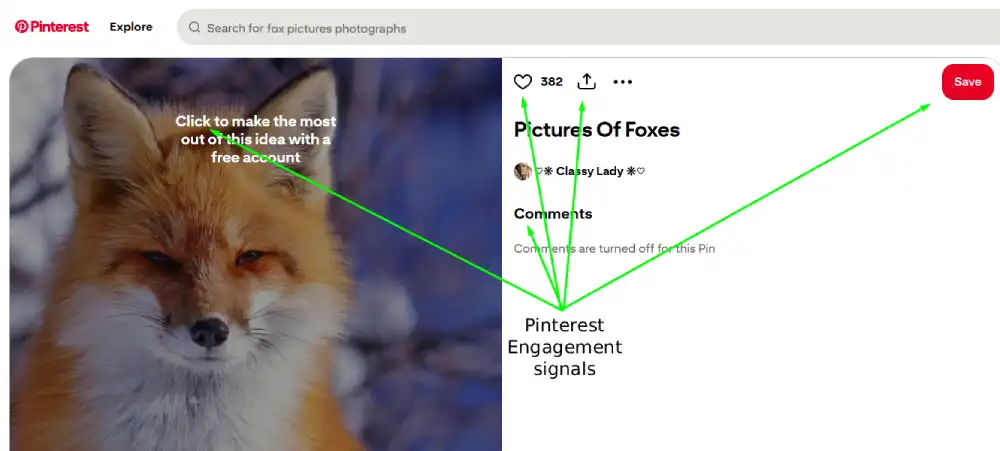
Pinterest has not published a full breakdown of how each signal is weighted. Based on available information, engagement does not replace relevance. A Pin must first match what someone is searching for or browsing. Engagement then helps determine how long and how widely that Pin is shown.
Think of engagement signals as confirmation, not magic. They reinforce what is already working.
Types of Pinterest Engagement Signals
1. Search Intent Match & Keyword Relevance
Search intent match determines whether a Pin is even eligible to appear in Pinterest search results or feeds.
Pinterest functions as a visual search engine. If a Pin does not clearly match what someone is looking for, it will not be shown, no matter how good the design is.
Relevance comes from:
- Pin title and description
- Board name and topic
- Visual content of the image itself
Pinterest has publicly stated that it uses both text and visual understanding. That means unclear images or vague wording weaken intent match. Strong engagement cannot fix poor relevance. This is the foundation every other signal depends on.
2. Saves (Previously Repins)
Saves are the strongest long-term engagement signal because they show planning and future intent.
Saving a Pin means someone wants to keep it. This aligns closely with how Pinterest is designed to be used. Pins that earn consistent saves often continue to surface weeks or even months later.
Saves also add context. When users save Pins to boards with clear titles, Pinterest gains more information about what the Pin represents.
While saves do not guarantee visibility forever, they are widely observed as the most durable signal for ongoing distribution.
3. Outbound Clicks
Outbound clicks show that a Pin motivated action beyond Pinterest.
When someone clicks through to a website, article, or product page, it suggests the Pin delivered on its promise. Pinterest has stated that it aims to connect people with helpful destinations.
However, clicks alone are not enough. If users return quickly or do not engage further, distribution may slow. Outbound clicks work best when they are consistent and paired with saves or strong relevance.
4. Pin Clicks (Close-Ups)
Pin clicks show curiosity and help Pinterest test early interest.
A Pin click happens when someone taps to view a Pin in detail. This often occurs during early distribution and helps Pinterest decide whether to show the Pin more widely.
High click activity without saves or outbound clicks usually leads to limited reach. This suggests that close-ups are an early signal, not a long-term one.
Clear visuals and readable text overlays strongly influence this signal.
5. Engagement Rate
Engagement rate compares interactions to impressions to provide performance context.
Engagement rate is typically calculated as total engagements divided by impressions, based on Pinterest Analytics. Pinterest does not publish an official formula, so small variations may exist.
This metric helps evaluate whether a Pin performs well relative to how often it is shown. A stable engagement rate over time is usually more meaningful than a short spike.
Engagement rate should be used for insight, not as a goal by itself.
6. Fresh Pins
Fresh Pins support initial testing but do not override relevance or engagement.
Pinterest has confirmed that new content is important. Fresh Pins give the system new material to test with users.
However, freshness fades quickly without engagement. Older Pins with strong saves and clicks can outperform newer ones. Freshness opens the door, but it does not keep it open.
7. Impressions
Impressions show how often a Pin was displayed, not how valuable it is.
Impressions are a result of distribution decisions. They increase when engagement is positive and decrease when it is not.
High impressions without engagement usually decline over time. Impressions should be read as a visibility indicator, not a quality signal.
Why Pinterest Engagement Signals Matter
Engagement signals influence how widely and how long Pins are distributed in search-driven environments.
Pinterest relies on user feedback to understand what content helps people make decisions. Engagement supports that understanding.
Pins with positive engagement tend to be tested with larger audiences. Pins with weak engagement often stop circulating. This process is gradual and contextual, not instant.
Engagement helps Pinterest learn. It does not force outcomes.
Relationship Between Engagement and Distribution
Engagement affects distribution by shaping how Pinterest expands, or limits reach.
Most Pins start with limited exposure. If users interact positively, Pinterest may show the Pin to more people. If not, reach usually slows.
Distribution often grows in stages. This explains why some Pins take time to gain traction. There is no guaranteed timeline or pattern.
Engagement vs Keyword Optimization
Keywords enable visibility, while engagement sustains it.
Keywords and intent match allow a Pin to appear. Engagement determines whether it continues to appear.
Optimizing only one side leads to inconsistent results. Both are necessary, and neither replaces the other.
How Pinterest Uses Engagement Signals
Pinterest uses engagement as feedback to refine content matching and distribution decisions.
Pinterest has not shared a detailed algorithm. Official statements indicate that engagement helps systems learn what content people find useful.
Any claim beyond this remains unconfirmed. It is best to focus on observable patterns rather than assumptions.
How to Improve Pinterest Engagement Signals in 2026
Pin Design and Visual Clarity
Clear, focused visuals help users understand value quickly.
Strong Pins are easy to read on mobile, visually specific, and aligned with the linked content. Confusing or decorative designs often reduce engagement.
Keyword and Topic Relevance
Matching real search behavior improves both visibility and interaction.
Use specific language and clear topics. Avoid broad or vague descriptions. Board context should reinforce the same theme.
Consistent Publishing
Consistency supports learning and momentum without guaranteeing results.
Regular publishing helps Pinterest test content patterns. Quality and clarity matter more than volume.
Common Misunderstandings About Pinterest Engagement
Engagement does not override relevance, and no single metric controls reach.
Common myths include believing impressions cause ranking or that posting daily guarantees growth. Pinterest evaluates content holistically.
Simplifying the system often leads to frustration.
FAQ – Pinterest engagement signals
What are the most important engagement signals on Pinterest in 2026?
The most important Pinterest engagement signals in 2026 are search intent match, saves, outbound clicks, and Pin clicks. Relevance determines eligibility, while saves support long-term visibility. Clicks and outbound clicks signal interest and usefulness. Pinterest has not confirmed a fixed priority, but these signals work together contextually.
How does Pinterest use engagement signals to rank Pins?
Pinterest uses engagement signals as feedback to guide distribution, not as fixed ranking scores. When users save, click, or interact with a Pin, Pinterest learns whether it meets user needs. Positive engagement can lead to broader testing and longer visibility, but only if the Pin already matches search intent and topic relevance.
What is a good engagement rate on Pinterest in 2026?
Pinterest does not define a universal good engagement rate. A strong engagement rate depends on niche, impressions, and Pin age. Consistent engagement over time is more meaningful than short spikes. Engagement rate should be used to compare Pins within the same account rather than against a global benchmark.
How do saves, clicks, and outbound clicks each impact Pinterest reach?
Saves signal long-term value and often extends a Pin’s lifespan. Pin clicks show initial interest and help with early testing. Outbound clicks indicate high intent and usefulness beyond Pinterest. Together, these actions help Pinterest decide whether to expand or limit distribution to larger audiences.
Which posting frequency and timing generate the strongest engagement signals on Pinterest?
Pinterest has not published official posting frequency or timing rules. Consistent publishing within a clear topic tends to perform better than irregular bursts. Engagement is driven more by relevance and clarity than by exact posting times. Testing consistency matters more than chasing specific days or hours.
How is Pinterest’s engagement rate calculated in 2026?
Based on Pinterest Analytics, engagement rate is calculated by dividing total engagements by impressions. Engagements typically include saves, Pin clicks, and outbound clicks. Pinterest does not publish a single official formula, so slight variations may exist. The metric provides context, not a guaranteed performance benchmark.
Conclusion
Pinterest engagement signals reflect how well content serves real people. Relevance opens the door. Engagement keeps it open. Consistency helps the system learn.
There are no shortcuts, only clarity, usefulness, and patience. When Pins genuinely help users plan and decide, engagement follows naturally.