
Pinterest has 553 million monthly active users worldwide (according to Pinterest’s business data).
That scale makes it one of the most powerful visual search platforms available to creators and businesses today.
With that reach comes a real responsibility: how you optimize matters not just for your rankings, but for the experience of every pinner in your audience.
Most articles on Pinterest SEO focus on tactics. This one covers something equally important, the ethical side.
Because the tactics that get you penalized, shadow-banned, or suspended are almost always the ones that cut corners on honesty.
Here’s what ethical Pinterest SEO looks like in practice, and why it consistently outperforms the shortcuts.
Table of Contents
Key Takeaways
- Pinterest is a visual search engine; its algorithm rewards relevance, quality, and trust, not manipulation
- Keyword stuffing in pin descriptions hurts both readability and rankings
- Pinning images without proper attribution violates Pinterest’s copyright policy and can result in account strikes
- Fake engagement (bots, bulk-follows, mass saves) violates Pinterest’s community guidelines and triggers spam flags
- Sustainable Pinterest growth comes from consistent, authentic, niche-specific content, not shortcuts
Why Ethics Matter on a Search-First Platform
Pinterest isn’t structured like Instagram or Facebook. People don’t scroll it passively. They come with intent, searching for recipes, design ideas, product inspiration, and tutorials.
The average Pinterest session lasts 14 minutes, which is long by social media standards. That means users are engaged, and they notice when content is misleading or low-quality.
Pinterest’s algorithm in 2026 still centers on three core signals: relevance (does your pin match what someone searched for?), quality (is your visual clear and easy to understand at a glance?), and trust (are you a real person or brand posting consistently and honestly?).
That trust signal is where ethics become directly relevant to your SEO performance. Pinterest now factors in authenticity markers such as verified merchant badges, domain trust, and consistent activity when deciding what to rank. In other words, your reputation on the platform is part of your ranking strategy.
The Problem With Keyword Stuffing
Keyword stuffing is one of the most common mistakes creators make on Pinterest, and one of the most damaging to long-term performance.
While adding a bunch of keywords can help a pin be found, Pinterest prioritizes content that is formatted correctly. At Pinterest’s Content Creators Conference, Pinterest highlighted keyword stuffing as a top error they see across business accounts.
Stuffing keywords into titles, descriptions, and hashtags makes it difficult for users to read and ruins the experience.
Pinterest’s algorithm reads your content the way a user does. When a description feels robotic, it signals low quality, and lower-quality content gets deprioritized in the Smart Feed.
The ethical (and effective) alternative is writing descriptions as natural sentences that happen to include your target keywords.
Use natural language to make your content more readable and avoid keyword stuffing. Adding keywords to pin descriptions and alt-text enhances discoverability while keeping the experience useful for real users.
A good rule: read your PIN description out loud. If it sounds like a list of search terms, rewrite it as a sentence. A description like “healthy meal prep ideas, quick easy weeknight dinners budget recipes” should become “Quick weeknight meal prep ideas that keep your grocery budget in check.”
The description does double duty, sharing keywords for search purposes, but also encouraging the user to click through. Making it feel like there is a real human behind it is what drives action.
Spam, Bots, and Fake Engagement
Pinterest is explicit in its community guidelines about what counts as spam. The platform prohibits sending repeated or unsolicited messages, making repetitive or irrelevant comments, using automation that hasn’t been explicitly approved by Pinterest, creating accounts en masse, and creating or saving content that is repetitive, deceptive, or irrelevant in an attempt to make money.
The temptation to use third-party tools that auto-follow, auto-save, or auto-comment is understandable, but growth takes time. But those tools almost always operate outside Pinterest’s approved partner ecosystem.
Deceptive spam includes link cloaking to hide where users are being sent, faking engagement with bots, or promoting outright scams.
Pinterest’s community guidelines are built on authenticity, and these behaviors are explicitly prohibited.
Accounts flagged for spammy behavior face blocks ranging from 30 minutes to full suspension. More importantly, artificially inflated engagement doesn’t translate into real traffic.
The pinner who saves your content because a bot made it look popular won’t click through, won’t buy, and won’t return.
Consistency is the honest path forward. If you want to build authority and maintain visibility in the Smart Feed, pin regularly and with intent.
Instead of uploading 50 pins in one day and going quiet for a week, aim for a consistent daily rhythm. A good starting point is 5 to 15 pins per day, spaced out at optimal times.
Copyright, Attribution, and Image Ownership
This is the area where many Pinterest marketers unknowingly cross an ethical line. Pinterest is built around visual content, and most visual content is protected by copyright.
Pinterest images are not automatically copyright-free. Pinterest is a discovery and bookmarking platform.
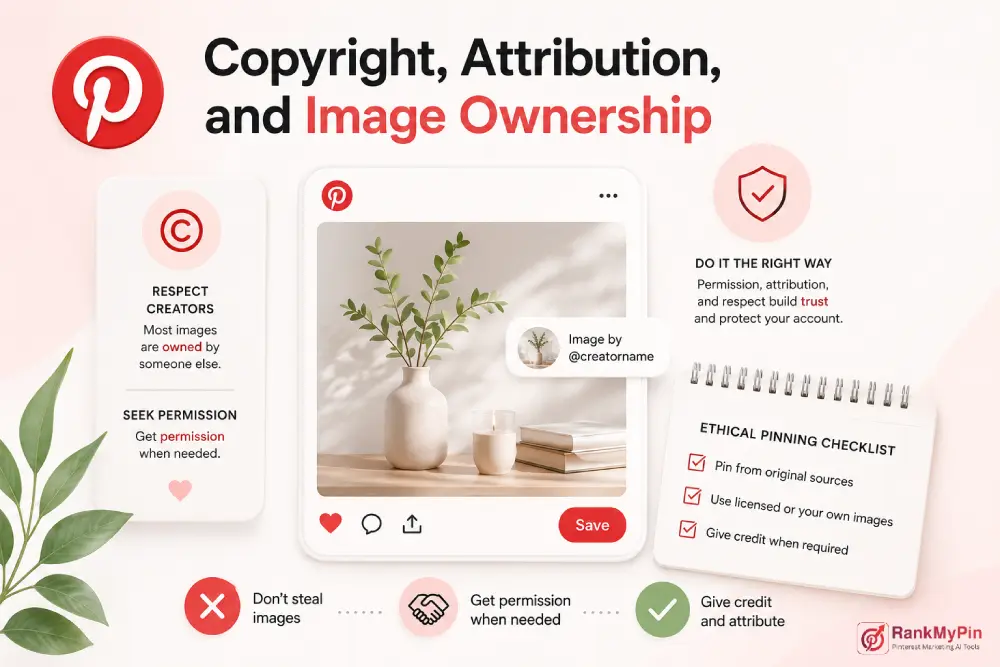
Most images on Pinterest are owned by someone else, and Pinterest itself states that you should seek permission from the copyright holder when needed.
Pinterest respects intellectual property rights and expects users to do the same. Accounts that repeatedly infringe copyrights can be disabled or terminated, and pins removed in response to copyright infringement reports result in strikes toward Pinterest’s repeat infringer policy.
Practically speaking, this means:
- Pin from original sources. When you save a recipe, tutorial, or product image, click through to its source and pin from the original page, not from a repost.
- Use your own images or licensed stock. Original photography, branded graphics, and properly licensed stock images (from platforms like Unsplash, Pexels, or paid stock sites) are safe to pin.
- Get permission for third-party creative work. If you want to feature a photographer’s image or an illustrator’s design, contact the creator or site owner and request written permission. Keep the documentation, and attribute when the license requires it.
- Understand that attribution isn’t the same as permission. Crediting a photographer in your pin description is good practice, but it doesn’t replace the legal right to use their work.
Pinterest offers a Content Claiming Portal where original creators can have their media attributed or removed across the platform. If you create original content, claiming it protects your work signals trust to the algorithm.
Transparency in Commercial Content
If you’re using Pinterest for affiliate marketing, sponsored content, or product promotion, transparency is both an ethical obligation and, in many jurisdictions, a legal one.
The FTC’s Endorsement Guides require that paid partnerships and affiliate relationships be disclosed clearly and conspicuously. Pinterest itself requires disclosure in promoted pins, but organic affiliate pins and sponsored collaborations are equally subject to FTC rules.
Ethical practice means labeling affiliate pins clearly (for example, “contains affiliate links” in the pin description) and not disguising promotional content as organic recommendations.
Audiences who discover undisclosed promotions lose trust fast, and on Pinterest, where the buyer journey often starts with a saved pin, that trust is core to conversion.
According to the 2025 Sprout Social Index, consumers prefer relatable, authentic, and entertaining content, underscoring that quality and honesty matter more than volume.
What Ethical Pinterest SEO Actually Looks Like
Putting it together, here’s what an ethical Pinterest SEO practice looks like day-to-day:
Content creation: Design original vertical graphics (1000 x 1500 px is the standard ratio), write pin descriptions as readable sentences with target keywords woven in naturally, and link only to content that delivers what the pin promises.
Keyword strategy: Use Pinterest’s native search bar to find real user queries. Type your topic and note the auto-suggested terms; those are actual searches. Place those terms in your profile bio, board titles, board descriptions, and pin descriptions. Pinterest reads everything: your profile, board titles, pin descriptions, and even the text overlaid on your images. Treat every pin like a mini SEO asset.
Board organization: Create boards with specific, keyword-rich names. “Home Decor” is too broad. “Small Living Room Decor Ideas” gives Pinterest’s algorithm (and your audience) a precise signal. Organize content into relevant, themed boards. This helps establish topical authority on the platform.
Engagement: Respond to comments genuinely. Save pins from other creators whose content aligns with your niche. Engage with your audience’s saves. Real interactions signal to Pinterest that your account is active and trusted.
Analytics review: Use Pinterest Analytics to understand which pins drive click-throughs, not just impressions. A pin with high saves but no clicks may need a stronger call to action in the description. Adjust based on actual data, not assumptions.
Frequently Asked Questions
Is keyword stuffing against Pinterest’s rules?
Pinterest’s community guidelines prohibit content that is repetitive or designed to manipulate the platform. While Pinterest doesn’t always penalize keyword stuffing immediately, it actively deprioritizes descriptions that read unnaturally. Beyond the algorithm, stuffed descriptions damage user trust and reduce click-through rates. Writing naturally while including target keywords is both the ethical choice and the more effective one.
Can I pin any image I find on Google or Pinterest?
No. Images found on Google Image Search or already pinned by others are almost always protected by copyright. Copyright protection applies the moment an image is created, regardless of whether a copyright notice is displayed. The safest approach is to use your own original images, properly licensed stock photos, or images where you have explicit written permission from the creator to use.
Do I need to disclose affiliate links on Pinterest?
Yes. The FTC requires clear disclosure of material connections, including affiliate relationships, in any content that promotes a product or service. In Pinterest pin descriptions, adding a clear note like “this pin contains affiliate links” at the start of the description is the straightforward way to comply. Many countries outside the US have similar advertising disclosure requirements.
What counts as spam on Pinterest?
Pinterest defines spam broadly: it includes repetitive or irrelevant comments, sending unsolicited commercial messages, using unauthorized automation tools, creating content that is deceptive or designed solely to generate money without providing real value, and operating fake accounts. Any behavior that artificially inflates engagement (bot saves, bulk follows, loop giveaways that violate platform rules) falls into this category.
How do I build Pinterest SEO ethically without buying followers?
Focus on consistent, niche-specific content creation. Pin daily, write genuinely useful descriptions, organize boards around specific audience needs, and link to destination pages that fully deliver on what the pin previews. Use Pinterest’s native keyword tools and analytics to refine your strategy over time. Growth built this way is slower but far more durable; the algorithm actively rewards accounts with authentic engagement history.
What happens if someone pins my original content without permission?
Pinterest allows you to submit a copyright infringement report through its official copyright form. You can request the removal of the content or request attribution. Repeat infringers face account-level action from Pinterest. If you create original images or video content regularly, registering with Pinterest’s Content Claiming Portal gives you ongoing protection and attribution control across the platform.
Build Something Worth Finding
Pinterest rewards the same things that ethical marketing has always rewarded: clear communication, honest representation, and genuine value for the audience on the other end of the pin.
The accounts that grow reliably on Pinterest in 2026 are not the ones that stuff descriptions with keywords or flood boards with low-effort repins.
They’re the accounts that show up consistently, protect the creator economy by respecting image rights, and treat every pin as a real entry point into a user’s decision-making process.
Shortcuts on Pinterest are increasingly short-lived. The platform’s trust signals are getting more sophisticated, its copyright enforcement is active, and its users are more discerning than ever.
The ethical path and the strategic path have converged. Do the honest work, and the algorithm will reflect it.