
Pinterest reports 5 billion searches each month from people looking for ideas, products, and solutions. Publicly available company data confirms that the platform remains one of the largest visual discovery engines online.
For brands, creators, and online businesses, this means a consistent opportunity if your content surfaces in search and home feeds.
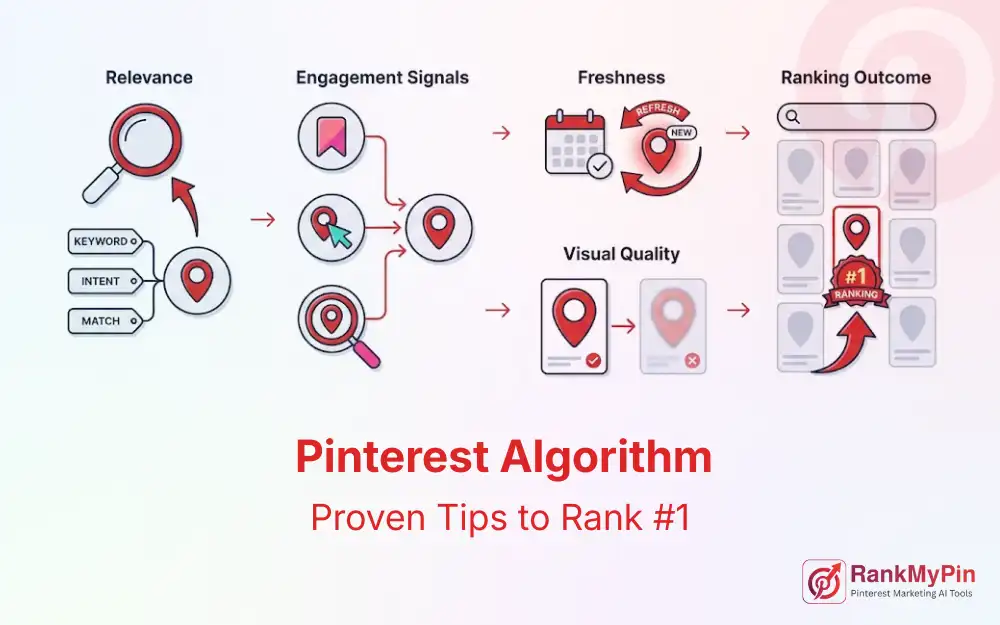
The Pinterest algorithm in 2026 ranks content based on relevance, engagement signals, freshness, and visual quality. It evaluates keywords, user behavior (saves, clicks, close-ups), and how well a Pin matches search intent. Understanding these factors helps increase visibility, traffic, and conversions.
Grow Your Pinterest Faster
Schedule pins, boost engagement, and get more followers effortlessly.
Why does mastering the 2026 algorithm matter? Because Pinterest is intent-driven. Unlike purely social platforms, users often arrive ready to plan, research, or buy.
When your Pins rank for high-intent searches, they can generate consistent traffic long after publishing.
In this guide, you’ll learn how the Pinterest algorithm works in 2026, what core ranking signals determine visibility, what has changed this year, and 7+ proven optimization tactics you can apply immediately. You’ll also discover the most common mistakes that quietly limit reach and prevent Pins from gaining consistent traction.
Table of Contents
Key takeaways:
- Focus on saves and keyword alignment. Saves signal long-term value, while strategic keyword placement ensures your Pins appear for the right searches. When both work together, they reach compounds over time.
- Prioritize vertical, mobile-friendly design. Clean 2:3 Pins with readable text overlays perform better because most users browse on mobile devices. According to Pinterest Business vertical images with a 2:3 aspect ratio are optimized to prevent truncated viewing in the feed.
- Publish consistently. Regular fresh content strengthens account authority and keeps you active in search distribution cycles.
- Use analytics to guide decisions. Identify which headlines, formats, and topics generate the most saves and clicks, then replicate what works.
- Leverage Idea Pins for engagement growth. Short-form educational or tutorial-style content can significantly increase interaction and expand reach.
Core Pinterest Algorithm Factors in 2026
Pinterest uses machine learning to organize and recommend content based on user interests and behavior patterns. While the company does not disclose exact formulas, official guidance and platform documentation confirm four core ranking pillars.
Pinterest prioritizes Pins that are relevant to a user’s search, receive strong engagement, stay visually high-quality, and align with current trends. Engagement (especially saves) and keyword relevance remain central ranking signals.
Below is a breakdown of the most important factors.
1. Pin Quality & Relevance
Pin quality and relevance determine whether Pinterest understands your content and considers it valuable for a specific search.
The platform analyzes visual clarity, keyword context, and landing page alignment to decide if your Pin deserves visibility in search results and home feeds.
Pinterest evaluates Pin Quality & Relevance based on:
- Strategic keyword placement in the title and within the first 100 characters of the description
- Clear alignment between the Pin image, headline promise, and destination page content
- High-resolution vertical formatting (2:3 ratio recommended)
- Readable text overlays optimized for mobile viewing
- Consistent topical focus across your boards and account
- Historical performance patterns of similar Pins within the same category
2. User Engagement Signals
User engagement signals show Pinterest how real users interact with your content. The more meaningful actions a Pin receives, the more likely it is to gain broader distribution across search and smart feeds.
To measure performance, Pinterest tracks:
- Saves, which indicate long-term usefulness
- Clicks to open and expand the Pin
- Close-ups for detailed viewing
- Outbound link taps to external websites
- Early engagement velocity after publishing
- Repeat interactions from returning users
3. Topic Alignment & AI Clustering
Topic alignment refers to how clearly your content fits within a defined niche. Pinterest uses AI-driven clustering to group related Pins and surface them to users who frequently engage with that topic.
To understand content relevance, Pinterest analyzes:
- Keyword consistency across titles, descriptions, and boards
- Thematic relevance of your overall account
- Patterns in user interaction within your niche
- Semantic relationships between related search terms
- Board naming structure and description clarity
- Content depth within a specific topic cluster
What Changed in the Pinterest Algorithm in 2026?
Pinterest continues to evolve toward video, mobile-first design, and AI-assisted discovery.
In 2026, Pinterest places increased emphasis on video and Idea Pins, stronger mobile formatting standards, and deeper semantic keyword understanding. Content that aligns with user intent and keeps users on-platform performs better.
The most important updates include:
- Increased distribution priority for short-form video and Idea Pins
- Stronger emphasis on mobile-first design and vertical formatting
- Improved AI-driven search intent matching and semantic keyword understanding
- Greater weighting of early engagement velocity after publishing
- Deeper topic clustering based on niche consistency across boards
- Enhanced analytics insights for tracking saves, clicks, and audience behavior
- Reduced visibility for low-quality, duplicated, or keyword-stuffed content
Video and Idea Pins now receive more feed visibility compared to static images in competitive niches. However, static Pins still rank well in search when optimized correctly.
Mobile optimization is no longer optional. Since the majority of Pinterest usage occurs on mobile devices, text overlays must be readable on small screens.
1. Keyword Research for Pinterest
Pinterest keyword research helps the platform understand what your content is about and when to show it in search results. Focus on long-tail, intent-driven phrases and place primary keywords naturally in your title and within the first 100 characters of your description.
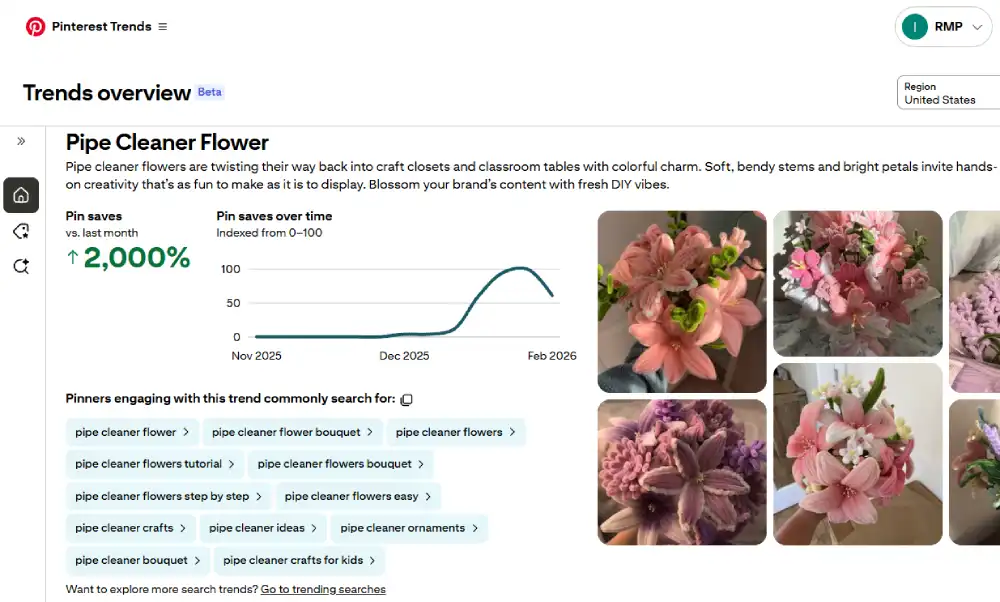
Effective strategy:
- Enter your core topic into the Pinterest search bar
- Review autocomplete suggestions for popular variations
- Analyze related search tiles that appear under results
- Compare keyword variations using Pinterest Trends (where available)
- Identify seasonal spikes tied to your niche
Examples of long-tail queries:
- Pinterest algorithm 2026 tips
- How to grow Pinterest traffic fast
- Pinterest marketing strategy for beginners
Front-load primary keywords in titles for clarity and stronger search alignment.
2. Pin Design Best Practices
Pin design directly impacts engagement. Use a vertical 2:3 ratio (1000×1500 pixels is commonly recommended), ensure mobile readability, and keep text overlays clear and minimal to improve clicks and saves.
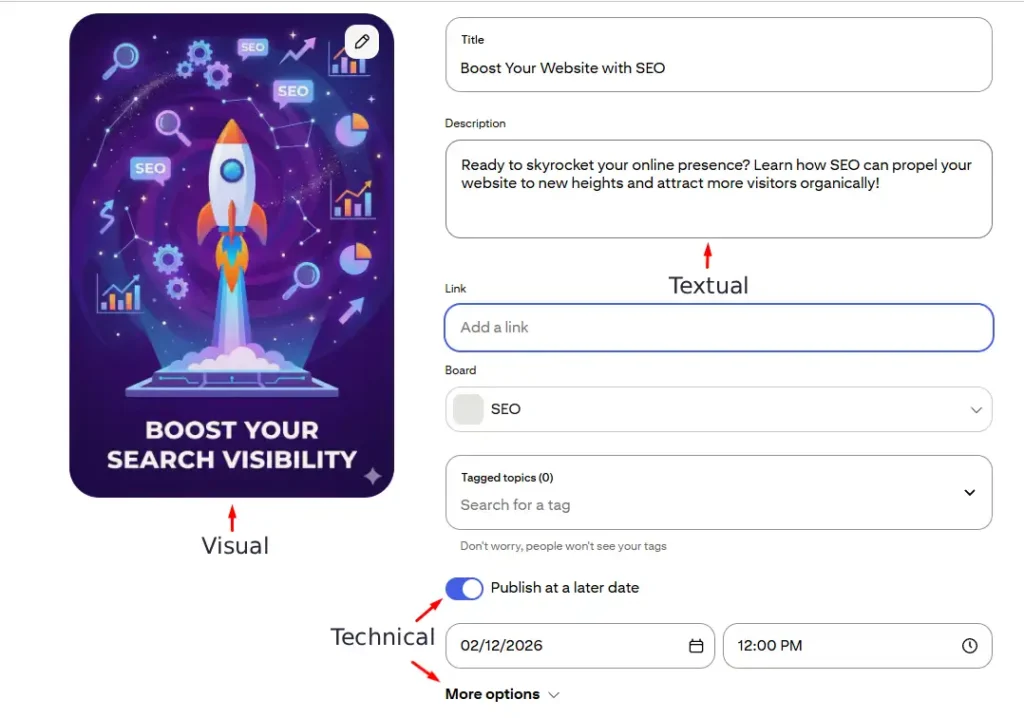
Design principles:
- Maintain a strong contrast between text and background
- Use clean, easy-to-read fonts
- Focus on one clear message per Pin
- Avoid clutter or excessive visual elements
- Keep branding subtle but consistent
- Ensure text is readable on small screens
Consistent formatting builds recognition and encourages repeat engagement.
3. Freshness Strategy
Pinterest favors fresh content. Publishing new Pins consistently and updating seasonal content helps maintain distribution in search results and home feeds.
Best practices:
- Publish 5–10 fresh Pins per week if manageable
- Refresh seasonal content 30–60 days before peak demand
- Create multiple design variations for the same URL
- Update headlines to test different angles
- Schedule content consistently rather than posting in bursts
Avoid reposting identical images repeatedly. Instead, create new visual variations with different layouts or messaging.
4. Enable Rich Pins
Rich Pins automatically pull structured data from your website, adding extra information such as product pricing or article headlines. This increases transparency and can improve click-through performance.
Types of Rich Pins:
- Product Pins
- Article Pins
- Recipe Pins
How to enable Rich Pins:
- Add appropriate metadata (Open Graph or schema markup) to your website
- Validate your URL using Pinterest’s Rich Pin validator
- Submit for approval if required
Structured data improves content clarity and supports stronger indexing.
5. Optimize Your Boards
Well-structured boards help Pinterest understand your niche authority. Create tightly themed boards with keyword-focused titles and detailed descriptions.
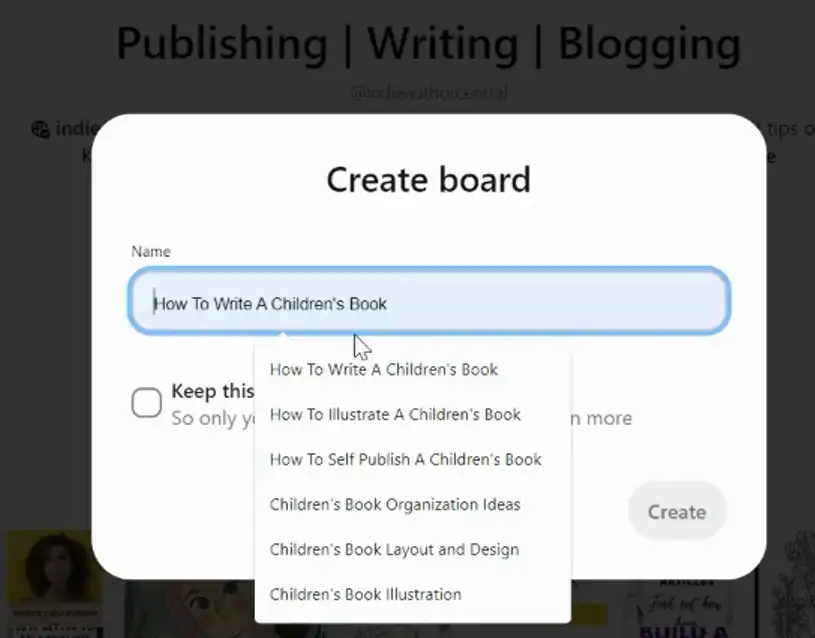
Best practices:
- Use specific, keyword-rich board names
- Write 2–3 sentence descriptions explaining the board topic
- Keep each board tightly focused on one subtopic
- Aim for at least 50 high-quality Pins per board
- Avoid mixing unrelated topics within one board
Example:
Instead of Marketing, use Pinterest Marketing Strategies for Small Businesses.
Clear board structure improves topical classification.
6. Use Pinterest Analytics Strategically
Pinterest Analytics reveals which Pins generate the most engagement. Reviewing performance weekly allows you to double down on winning formats and refine underperforming content.
Track these metrics:
- Top 10 Pins by saves
- Highest outbound click-through rates
- Engagement rate trends over time
- Seasonal traffic patterns
- Performance differences between static and video Pins
Identify repeat patterns in headlines, visuals, and topics. Replicate what consistently earns saves and clicks.
7. Leverage Idea Pins
Idea Pins use short-form video or multi-slide formats to increase engagement and build audience connection. They are designed to keep users interacting on-platform.
Tips for Idea Pins:
- Keep videos concise and focused
- Add captions for silent viewing
- Deliver step-by-step instructions
- Use strong hooks in the first few seconds
- Include clear value-driven takeaways
Tutorials, how-to guides, and educational breakdowns typically perform well in this format.
Pinterest Algorithm Weight Breakdown
Pinterest does not publish official weight percentages. However, based on platform guidance and performance patterns, the relative influence appears to align roughly as follows:
| Factor | Estimated Influence | Quick Win |
| Saves / Engagement | 40% | Test 3 descriptions per Pin |
| Relevance / Keywords | 30% | Place keywords early in text |
| Freshness | 20% | Maintain consistent publishing |
| Visual Quality | 10% | Use clean 1000×1500 templates |
These figures are not officially confirmed but reflect observable ranking behavior.
Common Pinterest Algorithm Mistakes to Avoid
Pinterest reduces distribution when content appears low-value, misleading, or misaligned with user intent. Weak optimization choices can limit saves, clicks, and long-term visibility, even if your visuals look appealing.
List of the Top 7 Pinterest algorithm mistakes:
- Keyword stuffing without natural context or readability
- Writing generic descriptions that lack a clear benefit or outcome
- Linking to landing pages that don’t match the Pin’s promise
- Using misleading titles or clickbait-style text overlays
- Posting inconsistently while expecting steady growth
- Ignoring seasonal demand cycles within your niche
- Creating broad boards that mix unrelated or loosely connected topics
Actionable Pinterest Algorithm Checklist
Improving Pinterest performance requires structured execution. Focus on auditing existing content, strengthening keyword alignment, testing new formats like Idea Pins, and reviewing analytics consistently. Small, targeted optimizations compound over time.
Immediate actions to implement:
- Audit your 20 most recent Pins for keyword clarity in titles and the first 100 characters of descriptions
- Replace vague or generic descriptions with benefit-driven, intent-focused messaging
- Create at least 3 new Idea Pins this week, targeting one specific search query
- Review Pinterest Analytics every 7 days to track saves, clicks, and top-performing formats
- Optimize 3 boards by refining titles and adding clear, keyword-aligned descriptions
- Update 5 older high-potential Pins with improved headlines or redesigned visuals
- Schedule consistent weekly publishing to maintain content freshness signals
FAQs
How does the Pinterest algorithm rank Pins in 2026?
Pinterest uses machine-learning ranking systems that treat the platform as a visual discovery engine. It evaluates relevance to user searches, engagement signals like saves and clicks, content freshness, keyword alignment in titles/descriptions, and overall Pin quality. Pins that match intent and earn interactions are more likely to appear in search results and feeds.
What are the biggest Pinterest algorithm changes in 2026?
Pinterest’s ranking approach continues emphasizing fresh, relevant content with strong engagement. Recent trends highlight greater distribution of new Pins early after publishing, increased focus on video or multi-page formats like Idea Pins, and deeper keyword understanding. These shifts reward searchable, intent-aligned content.
How can I optimize Pins to beat the Pinterest algorithm?
To improve ranking, use clear, keyword-rich titles and descriptions that match search intent, post high-quality vertical visuals, and publish consistently. Encourage saves and clicks by using engaging designs and formats like Idea Pins. Monitor Pinterest Analytics and refresh high-performing content seasonally.
Why do video Pins perform better than static images now?
Video and multi-page formats like Idea Pins often receive broader visibility because they tend to generate stronger engagement and more time spent on content. Pinterest’s ranking models favor formats that hold attention and encourage interaction, which can help improve reach and discovery compared with static images alone.
How important are keywords in Pinterest descriptions in 2026?
Keywords in Pin titles and descriptions are essential because Pinterest functions as a visual search engine. Placing relevant search phrases naturally helps the system understand and match your content to user queries, increasing the likelihood your Pins appear in search results and related feeds.
What mobile optimization is required for Pinterest success?
Mobile optimization matters because most users access Pinterest on mobile devices. Use vertical 2:3 visuals, readable font sizes, minimal clutter, and clear text overlays to ensure Pins are easily scanned and interacted with on small screens. This enhances engagement signals, which supports higher ranking.
Conclusion: How to Win the Pinterest Algorithm in 2026
Based on Pinterest’s current platform guidance and ranking patterns, content that demonstrates clear relevance, strong engagement signals, consistent publishing, and high visual quality tends to perform better in search and home feeds.
Instead of trying to implement every tactic at once, focus on one improvement area this week, whether that’s keyword alignment, Pin design, or publishing consistency. Strategic, incremental optimization is more sustainable and often more effective than rapid, unfocused changes.