
There is a dangerous misconception that still plagues small business owners in 2026: the idea that Pinterest is a social media platform.
If you are treating Pinterest like Instagram or TikTok, chasing likes, engaging in follow loops, and posting life updates, you are already losing.
Pinterest is not social media; it is a Visual Discovery Engine. While other platforms fight for your attention span, Pinterest fights for your intention.
For the solo creator or the eCcommerce brand, this distinction is the greatest arbitrage opportunity of the decade. You don’t need a million followers to win here. You need a strategy that leverages Pinterest SEO.
In 2026, the algorithm has evolved significantly. It’s no longer just about pretty pictures; it’s about Semantic Relevance, Freshness, and deep User Intent.
This guide removes the guesswork. We will break down exactly how the machine functions, how to feed it the data it craves, and how to position your content to outrank giant corporations with massive budgets.
Table of Contents
Key Takeaways: Pinterest SEO in 2026
- Pinterest = Search: Treat your profile like a website and your pins like blog posts. The algorithm prioritizes keywords and relevance over social clout.
- Freshness is King: The 2026 algorithm punishes content dumping. It rewards the consistent creation of new, unique image URLs that lead to valuable content.
- Consistency Builds Trust: Random pinning confuses the AI. Regular, daily activity builds Topical Authority for your domain.
- Visuals are Keywords: The Visual Graph scans your images for objects and context. Your image is a keyword.
- Intent Layering: Ranking requires optimizing three distinct layers: The Domain, the Board, and the Pin itself.
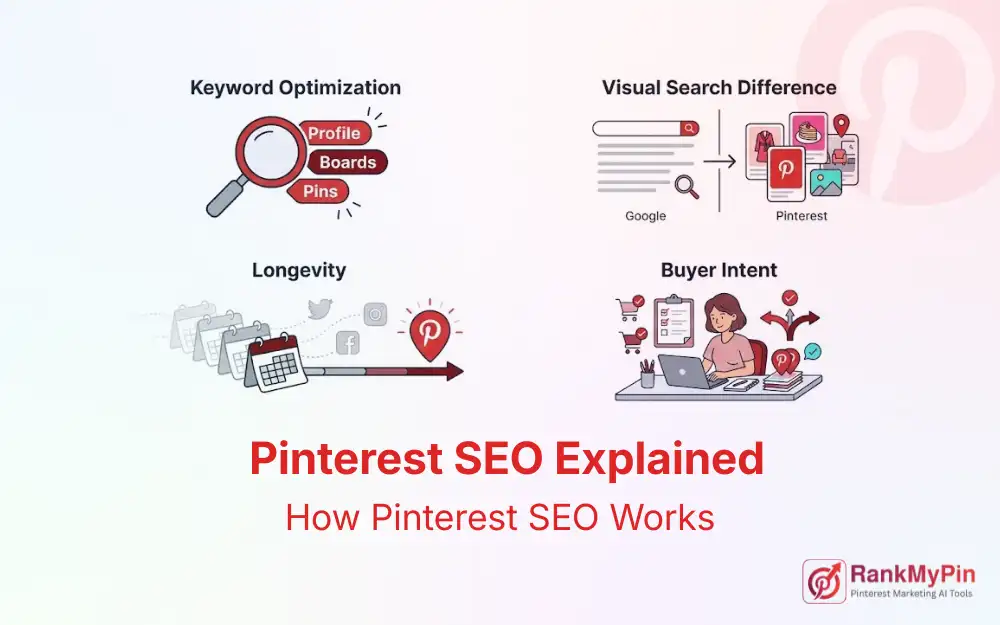
What is Pinterest SEO?
Pinterest SEO is the strategic process of optimizing your profile, boards, and pins with specific keywords and visual signals so the Pinterest algorithm can properly categorize and distribute your content to users searching for it.
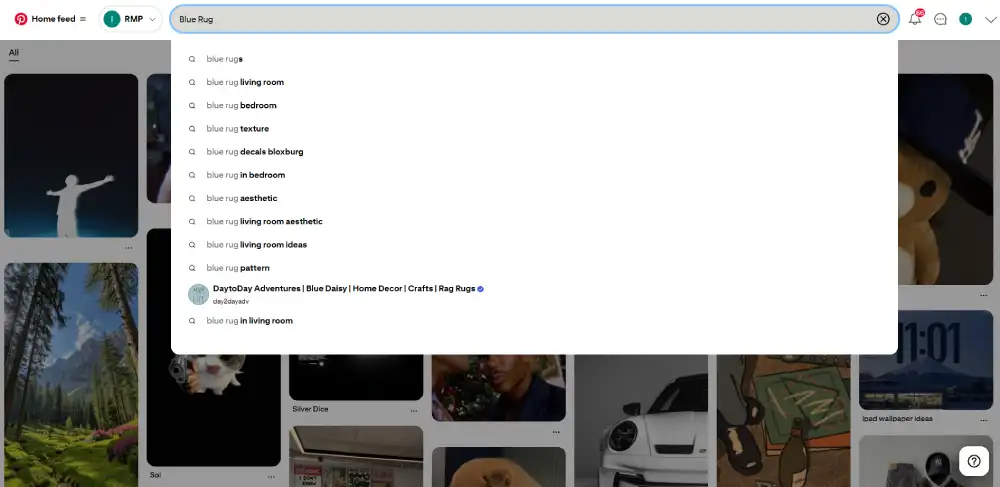
To win, you must understand the fundamental difference between the two giants of search:
- Google is text-heavy and answer-focused.
- Pinterest is visual-first and inspiration-focused.
Why does this matter in 2026? Because of Longevity. A tweet lasts for minutes; an Instagram story lasts for 24 hours. A well-optimized Pin lasts for months or even years.
We have seen pins created in 2023 still driving thousands of clicks today because they continue to answer a specific search query relevant to the user.
According to data from Pinterest Business, users on the platform are often in a planning mindset, making them significantly more likely to convert into buyers than passive scrollers on social feeds.
When you optimize for Pinterest SEO, you are not just getting views; you are getting future customers who are actively looking for a solution.
The 4 Pillars of the Pinterest Algorithm in 2026
To rank in 2026, you must act like a media company. You are managing assets, and the algorithm judges those assets based on four specific pillars.
1. Domain Quality
This is the foundation. How much does Pinterest trust your website? If you haven’t Claimed your website or enabled Rich Pins, you are invisible. A verified merchant status and high-quality, safe content on your destination link tell the algorithm you are a legitimate source, not a spammer. In our testing, accounts that failed to claim their domain saw a 40% reduction in distribution for the exact same content compared to verified accounts.
2. Pin Quality
This measures engagement signals. The algorithm watches how users interact with your Pin. Do they save it? (High value). Do they click through? (High intent). In 2026, the Long Click is a critical metric; if users click your pin but immediately bounce back to Pinterest, your Pin Quality score drops.
3. Pinner Quality
This is your reputation score. Do you pin consistently, or do you ghost for weeks and then spam 50 pins in an hour? The 2026 algorithm rewards consistency. It prefers a creator who pins 5 times a day, every day, over one who pins 100 times once a month. This signals to the AI that you are an active, reliable contributor to the ecosystem.
4. Topical Relevance (The Visual Graph)
This is the most critical pillar for SEO. This is how well your keywords match the user’s search query. However, in 2026, this goes beyond text. Pinterest’s AI reads your image.
If a user searches for Minimalist Home Office, and your Pin image shows a cluttered desk while your text says Office Tips, you fail the relevance test. The visual pixels must match the text keywords.
Step 1: Master Your Keyword Research (Data Over Guessing)
You cannot guess what people are searching for. You must use data. This is where most creators fail: they write cute, clever titles instead of clear, searchable ones.
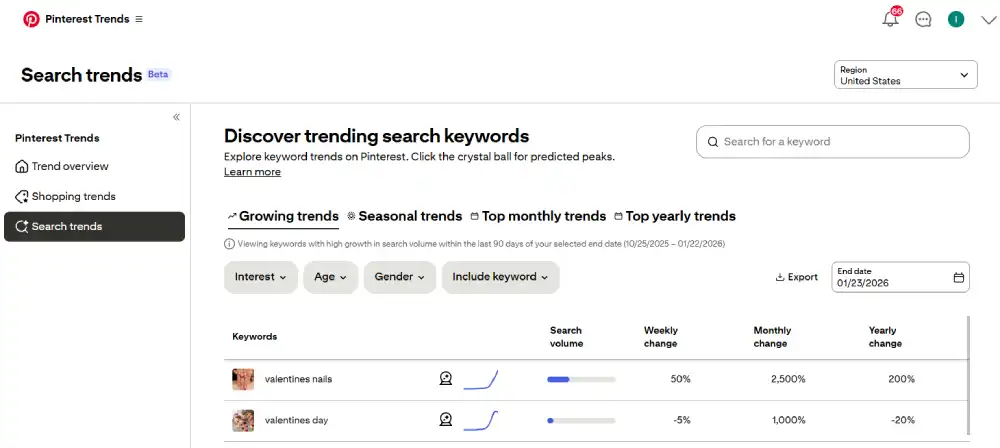
There are two types of keywords you need to master:
- Broad Terms: High volume, high competition (e.g., Home Decor).
- Long-Tail Keywords: Lower volume, specific intent, high conversion (e.g., Boho Living Room Decor on a Budget).
How to execute a keyword strategy:
- Input your niche: Enter a broad term like Healthy Recipes.
- Analyze the Long-Tail: The tool will generate specific phrases like 30-Minute Keto Dinner for Beginners.
- Map to Content: Use these exact phrases as the foundation for your Pin Titles and Board names.
Manual vs. Automated Strategy: A Decision Guide
You have limited time. Here is how to decide between manual research and using a tool.
| Feature | Manual Execution | RankMyPin Execution |
| Keyword Research | Typing queries into the search bar manually to see auto-suggest results. (Time: 30+ mins) | Using Pinterest Keyword Generator to get 50+ volume-backed keywords instantly. (Time: 2 mins) |
| Trend Analysis | Scrolling the Trends tab, hoping to spot a pattern. | Data-driven analysis of rising interests. |
| Accuracy | High risk of Recency Bias (seeing what you want to see). | Pure data based on search volume. |
| Cost | Free (Cost: Your Time) | Free (Cost: $0) |
The Verdict:
- If you are a hobbyist posting for fun, manual research is perfectly fine.
- If you are building a business and need to scale traffic, you should use the RankMyPin Pinterest Keyword Generator to ensure every pin targets a verified search term.
Step 2: Optimizing Your Profile and Boards
Your profile is not a vanity project; it is a landing page for the search engine bot.
Profile Optimization
Your bio should clearly state who you help and include your main keywords.
- Bad Bio: Mom of 3, coffee lover, dreaming big.
- SEO Bio: Helping Small Businesses master Pinterest Marketing and Social Media Strategy. Daily tips for Digital Growth.
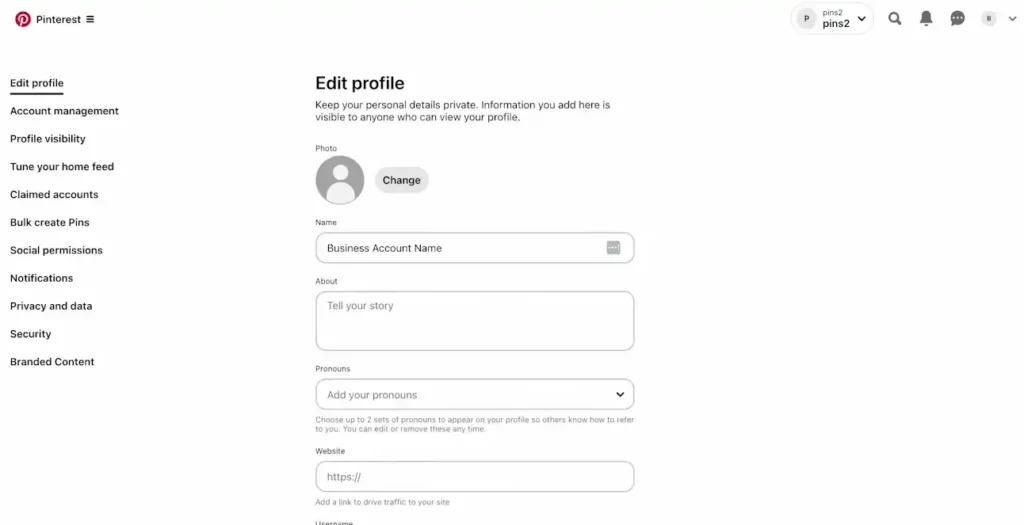
Board Architecture
Think of your Boards as the categories of your blog. Pinterest looks at the Board title to understand the Pins inside it. If you pin a Vegan Burger recipe to a board named Yummy Stuff, the algorithm is confused. If you pin it to Vegan Dinner Recipes, the algorithm understands exactly what it is.
Board Optimization Checklist:
- Title: Clear, keyword-rich names. Avoid symbols or fancy fonts that the AI cannot read.
- Description: Write 2-3 full sentences for every board description. A collection of the best Vegan Dinner Recipes for busy weeknights, including gluten-free options and meal prep ideas.
- Category: Ensure you have selected the correct Board Category in the settings (e.g., Food & Drink).
Step 3: Creating and Optimizing Fresh Pins
In 2026, the concept of Fresh Pins is the law. A Fresh Pin is defined as a new image that leads to a URL.
Repinning the exact same image 50 times is spam and can get your account flagged. Creating 5 different image variations for 1 blog post is a strategy.
Visual Optimization
- Aspect Ratio: Always use vertical images (2:3 aspect ratio, or 1000×1500 pixels). Square images get lost in the feed.
- Text Overlay: This is critical for mobile users. The text on the image should be a hook, not just the title. (e.g., 5 Mistakes Killing Your Reach vs. Pinterest Tips).
- Branding: Use consistent fonts and colors. This builds visual recognition with your audience.
Text Optimization (The Metadata)
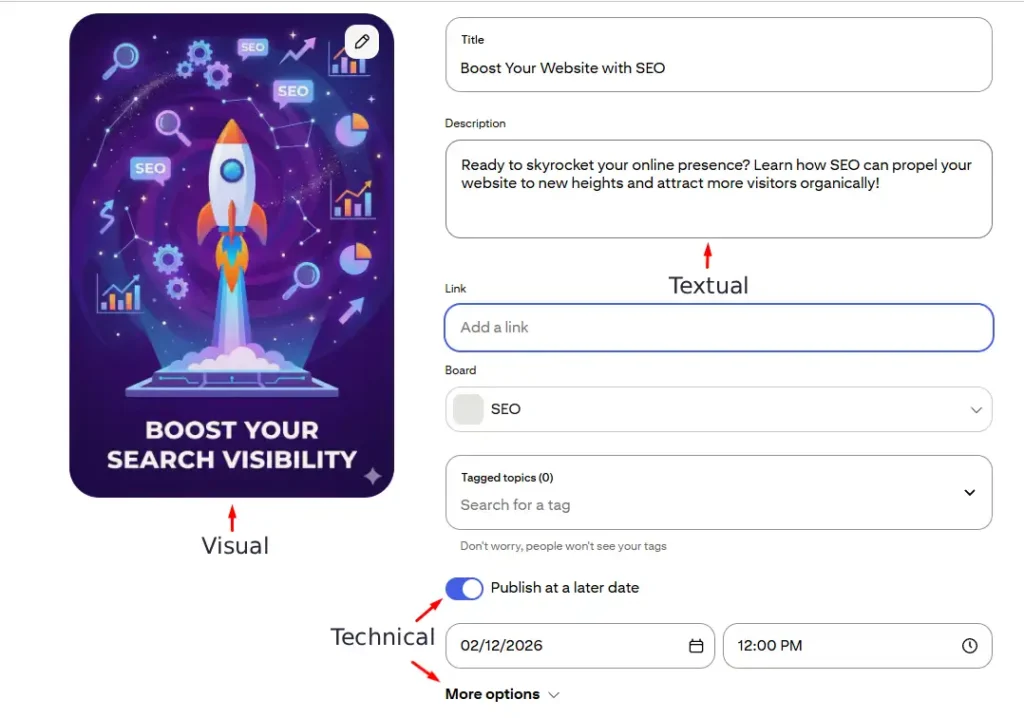
Follow this specific workflow to ensure maximum indexability.
Step 1: The File Name
Never upload IMG_5920.jpg. Rename your file to your target keyword before uploading, e.g., pinterest-seo-strategy-2026.jpg. This is the very first signal the algorithm reads.
Step 2: The Title
Place your Primary Keyword at the very beginning of the title.
- Weak: How I grew my traffic.
- Strong: Pinterest SEO Strategy: How I Grew Traffic by 200%.
Step 3: The Description
Use natural language. Do not keyword stuff. Write a helpful summary that naturally incorporates your main keyword and 2-3 semantic variations (LSI keywords).
- Example: Looking for a proven Pinterest SEO strategy? This guide covers how to optimize your pin descriptions and board titles to explode your blog traffic in 2026.
Step 4: The Alt Text
This is often ignored but vital for the Visual Surface. Describe the image for accessibility and SEO. Infographic showing the 4 pillars of Pinterest SEO with charts and graphs.
Advanced Tactics: Rich Pins and Video
Rich Pins
Rich Pins are a technical SEO requirement. They add extra code to your pins that pull real-time data from your website.
If you change a headline or a price on your site, the Rich Pin updates automatically on Pinterest. This signals to Pinterest that your content is fresh and accurate.
- Article Pins: Show the headline, author, and description.
- Product Pins: Show real-time pricing and availability (Crucial for eCcommerce).
- Recipe Pins: Show ingredients and serving sizes.
Video Pins in 2026
Video is no longer optional. Sprout Social’s 2025 Index highlights that short-form video drives 2.5x more engagement than static images. However, you cannot just repost videos from other social platforms. Pinterest videos must be actionable.
The Key Moments Strategy:
Structure your video with clear text overlays: Step 1 (The Hook), Step 2 (The Value), Step 3 (The CTA). This structure encourages the algorithm to index the video as a process, often ranking it higher in search results for How-To queries.
Frequently Asked Questions
How does Pinterest SEO work?
Pinterest SEO works by matching the visual data of your image and the keywords in your text (Title, Description, Board Name) with a user’s search query. It assigns a relevance score to your content; the higher the score, the higher you appear in the search feed. It relies on consistency, domain quality, and user engagement signals like saves and clicks.
How has Pinterest changed in 2026?
In 2026, Pinterest has shifted heavily toward AI-driven visual recognition and Fresh Pins. The algorithm now prioritizes new, original images over repins. Additionally, there is a stronger integration of shopping features (Pinterest Shop) and video content, making Idea Pins and video assets crucial for SEO visibility.
How to get more views on Pinterest in 2026?
To get more views, you must publish Fresh Pins daily and use trend-jacking strategies. Focus on upcoming seasonal trends 45 days in advance (e.g., posting Christmas content in October). Use high-contrast vertical images (2:3 aspect ratio) and ensure your text overlay is legible on mobile screens.
Is Pinterest still relevant in 2026?
Yes, Pinterest is highly relevant, specifically for eCcommerce and high-intent traffic. Unlike social media where content disappears in 24 hours, Pinterest content is evergreen. A pin optimized for SEO can drive traffic for months or even years. It remains one of the most cost-effective traffic sources for bloggers and brands.
Should I use hashtags on Pinterest in 2026?
No, hashtags are largely obsolete for SEO in 2026. While they don’t hurt you, the algorithm relies almost entirely on keyword matching within the description and title. It is better to use that character space for natural, keyword-rich sentences than to clutter it with generic hashtags.
Can you still make money on Pinterest in 2026?
Yes, creators are making money through affiliate marketing, driving traffic to ad-monetized blogs, and direct eCcommerce sales. The Pinterest Shop integration has made it easier than ever to convert users directly on the platform. The key is to treat Pinterest as the top of your sales funnel, not just a gallery.
Conclusion: Stop Guessing, Start Executing
The era of posting and praying is over. In 2026, the winners are the ones who treat Pinterest SEO with the respect it deserves. It is a mathematical system, not a lottery.
By building a solid foundation, optimizing your domain, creating high-signal visual assets, and using data-backed keywords, you give your content the best possible chance to be seen.
You have the strategy. You have the tools. Now, go build your empire.