
The digital marketing playbook has been rewritten. In 2026, relying solely on paid ads or fleeting social media trends is a financial liability.
The smartest brands are returning to the fundamentals of organic search, and Pinterest sits at the center of this revival.
Pinterest is not a social network where you shout into a void; it is a Visual Intelligence Engine where users whisper their intentions.
They come to plan, to dream, and eventually, to buy. Unlike the chaotic, short-lived feeds of TikTok or Instagram, Pinterest offers archival value. A pin you optimize today can drive traffic for years, not hours.
However, the algorithm that powers this engine has evolved. It no longer relies on simple text matching.
Pinterest appears to prioritize Semantic Entity Indexing and advanced Computer Vision to understand the context of your content. To rank in this new environment, you need a precise, technical strategy.
This guide details the top 11 Pinterest SEO best practices for 2026. By systematically applying these rules, you move from guessing to engineering, building a traffic asset that compounds in value over time.
Table of Contents
Quick Takeaways: The 2026 Protocol
- Trust is the New Viral: Verified domains and consistent activity beat viral spikes. The algorithm prioritizes Safe and Reliable sources.
- The Pixel is the Keyword: Your image must visually match your text metadata. If they contradict, you lose.
- Intent > Volume: Ranking for specific, low-volume keywords drives more revenue than ranking for broad, high-volume terms.
- The Ranking Window: The first 24 hours of a pin’s life determine its long-term ranking.
1. Treat Pinterest Like a Search Engine
The first and most important of our Pinterest SEO Best Practices is a mindset shift. Stop treating Pinterest like a social media platform and start treating it like Google for images.
Understand How Pinterest Ranks Content
Pinterest’s goal is to provide the best visual answer to a user’s query. It indexes your content based on three primary layers:
- The Visual Layer: What objects are in the image? (e.g., Sofa, Blue Rug).
- The Text Layer: What keywords are in the title, description, and overlay?
- The Engagement Layer: Did previous users find this helpful (did they save it)?
Focus on Relevance and Long-Term Visibility
Social media requires you to be Always On. Pinterest allows you to be Strategic. Your content does not need to be a trend to work; it needs to be a solution.
Whether it’s a recipe, a renovation tip, or a product, ensure it solves a problem that will still exist three years from now. This evergreen strategy is the foundation of high ROI.
2. Research Keywords Strategically
You cannot optimize what you haven’t defined. Most creators fail because they guess what their audience wants instead of looking at the data.
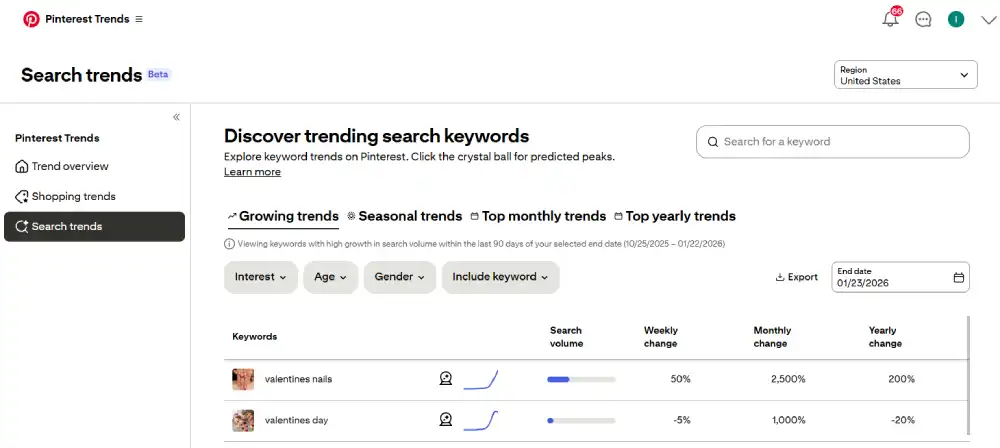
Use Pinterest Search Suggestions and Trends
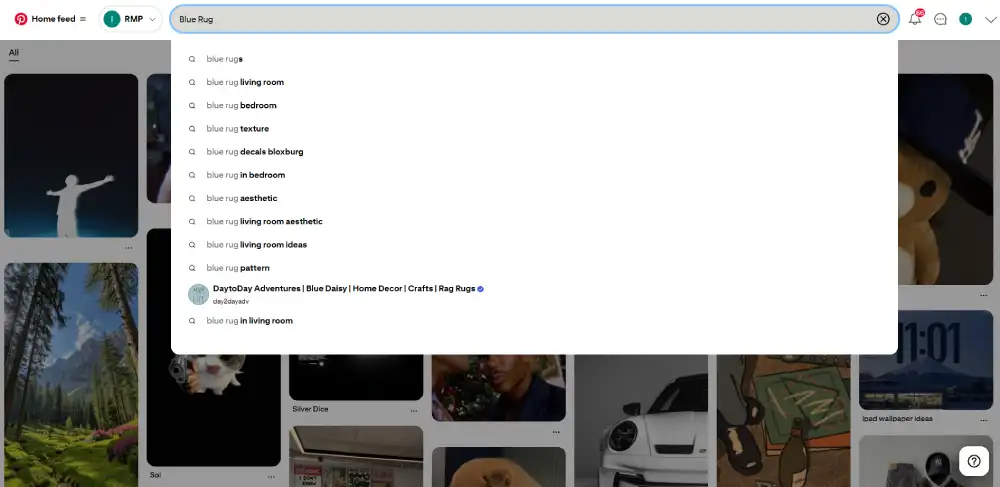
The Pinterest search bar is the most powerful and free research tool available. When you type a root keyword, the auto-suggest feature shows you exactly what users are searching for right now, ranked by volume.
- Action: Type “Living Room” and see the suggested modifiers: Modern, Boho, Small Space, Apartment. These are your Semantic Clusters.
Prioritize Long-Tail and Seasonal Keywords
Broad keywords are a trap. Ranking for Food is impossible. Ranking for 30-Minute Vegan Dinner for Kids is achievable and highly profitable.
Long-Tail Keywords signal high intent. A user typing five words is not browsing; they are looking for a specific solution. Structure your content to answer these specific queries.
3. Optimize Your Profile for Discoverability
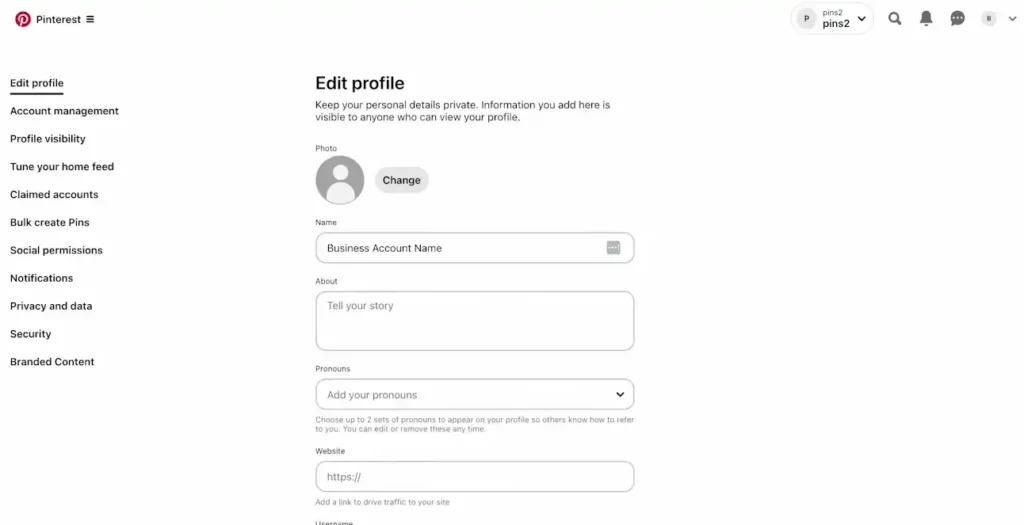
Your profile is your domain’s homepage within the Pinterest ecosystem. It assigns a Confidence Score to your account.
Clear Username and Display Name
Your username is part of your URL structure. It sends a permanent signal to search engines.
- Best Practice: Include your main keyword in your URL (e.g., @JaneDoeFitness) and your Display Name (e.g., Jane Doe | HIIT Workouts & Nutrition). This helps you rank for those terms even if users don’t follow you.
Keyword-Friendly Bio and Consistent Branding
Your bio is indexed metadata. Use it to state your value proposition clearly using keywords.
- Formula: Helping [Target Audience] achieve [Result] with [Topic 1] and [Topic 2].
- Example: Helping New Moms, mastering meal prep, and Budgeting with simple, healthy recipes.
Claim Your Website and Use Business Features
Claim Your Website as soon as possible. This places a verification checkmark next to your URL and tells the algorithm that you own the content you are pinning. Unclaimed domains are treated as Guest content, which has a lower distribution ceiling.
4. Create Focused, Relevant Boards
Boards are the directories of your library. If your filing system is messy, the librarian (the algorithm) cannot find your books (pins).
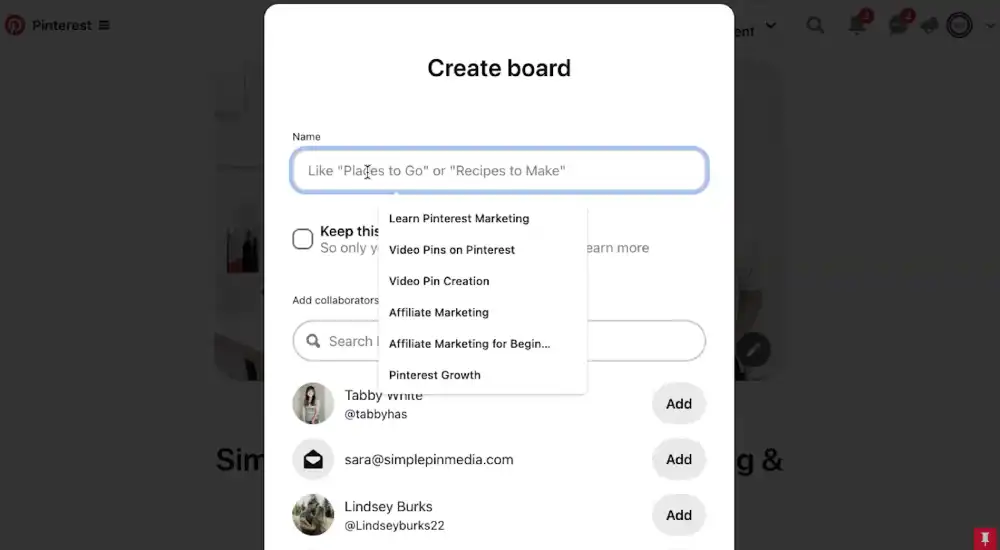
Use Clear, Search-Friendly Board Names
Avoid clever or abstract names like My Life or Things I Love. Use literal, keyword-rich names.
- Bad: Yummy Stuff
- Good: Gluten-Free Dessert Recipes
If a user has to guess what is inside the board, the name is wrong.
Write Descriptions That Help Both Users and Pinterest
Never leave a board description blank. This is prime real estate for Pinterest SEO Best Practices. Write 2-3 natural sentences that weave in your primary keyword and related LSI keywords.
Example: A collection of the best Home Office Ideas for small spaces. Find tips on desk organization, productivity hacks, and ergonomic furniture.
Organize Boards into Related Topic Clusters
Group your boards logically. If you cover Weddings, group your Wedding Dress, Wedding Cake, and Wedding Venue boards together.
This visual organization helps users navigate your profile and helps the algorithm understand your Niche Authority.
5. Design Pins That Stand Out
In a visual search engine, the pixel is the hook.
Use Vertical, High-Quality Images
The 2:3 aspect ratio (1000 x 1500px) is the standard. Horizontal images lose 60% of screen real estate on mobile devices, rendering them invisible.
- Quality Check: Ensure your images are high-resolution. Blurry or dark images are flagged as Low Quality.
Incorporate Image Text to Reinforce Messaging
The text on your image is read by the AI. It serves two purposes:
- Stop the Scroll: It grabs the human eye.
- Context: It reinforces the keyword relevance to the bot.
Use bold, high-contrast fonts. If the text is illegible, you miss a ranking signal.
Match Pin Visuals to User Intent
If the user searches for Minimalist Bedroom, do not show a cluttered room. Pinterest scans your image for objects. If the visual entities (objects, colors) do not match the search query, your pin is deemed irrelevant.
6. Write Titles and Descriptions That Drive Action
Your metadata is the sales pitch for the click.
Include Target Keywords Naturally
Your Pin Title is the H1 tag. Front-load your primary keyword.
- Weak: “My favorite tips”
- Strong: “Pinterest SEO Tips: How to Rank #1”
The first 30 characters are crucial for Click-Through Rate (CTR).
Use Descriptions to Explain Value and Encourage Clicks
Don’t just list keywords. Write a teaser. Use the Problem-Agitation-Solution framework to compel the user to leave Pinterest and visit your site.
- Example: Struggling to grow your traffic? This guide covers the essential Pinterest SEO Best Practices to double your reach in 30 days. Click to read the full strategy.
Add Hashtags Sparingly and Strategically
Hashtags are largely ignored in 2026. The algorithm’s semantic understanding renders them redundant.
If you use them, stick to 1-2 highly specific tags, but prioritize writing keyword-rich sentences instead.
7. Maintain a Consistent Pinning Schedule
Consistency is a trust signal.
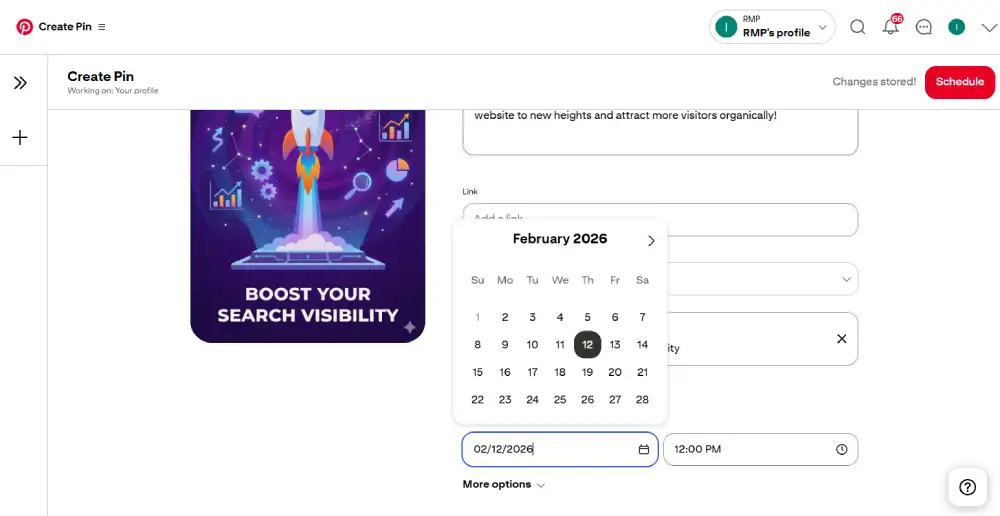
Balance Fresh Pins with Evergreen Content
The algorithm favors Fresh Pins (new image URLs). Repinning the same image 100 times is spam.
Focus on creating 5-10 unique image variations for your best-performing articles. This gives you multiple shots on goal without looking like a bot.
Pin Ahead of Seasonal Trends for Maximum Impact
Pinterest users are planners. They search for events 45 to 60 days in advance.
- The 45-Day Rule: If you pin Christmas Decor in December, you are too late. You must publish seasonal content in October to capture the ranking window as the trend rises.
8. Encourage Engagement Organically
Engagement validates quality.
Focus on Saves, Clicks, and Dwell Time
- Saves (Repins): Signal to the algorithm that the content is valuable and worth indexing long-term.
- Clicks: Signal commercial intent.
- Dwell Time: If users click and stay on your site, it signals high relevance.
Avoid Over-Pinning or Spammy Tactics
Pinning 50 times in one hour triggers spam filters. Pinning 2-5 times a day, every day, builds Pinner Quality. Use a scheduler to drip content out evenly.
Let Pins Gain Traction Over Time
Pinterest is slow. A pin might take 30 days to fully index and 3-6 months to peak. Do not delete a pin after 48 hours because it has low views. Let it simmer. It might just be waiting for the right seasonal trigger.
9. Align Pins With Landing Pages
The Click is a promise. The Landing Page is the delivery.
Ensure Visuals and Messaging Match Your Website
Visual Continuity is key. If your pin uses a Pastel Aesthetic and your website uses Dark Mode Neon, the user experiences subconscious dissonance and bounces. Ensure the visual transition is seamless.
Optimize Landing Pages for Mobile and Speed
85% of Pinterest users are on mobile. If your site takes 5 seconds to load or has intrusive pop-ups, users leave instantly. This Short Click behavior tells Pinterest your content is low quality.
Include Clear Calls to Action
Don’t assume users know what to do. On your pin overlay, use a CTA like Click to Download or Read the Guide. This simple psychological nudge increases CTR significantly.
10. Refresh and Update Existing Pins
Your library requires maintenance.
Improve Underperforming Pins Without Losing SEO Value
Do not edit the URL of a high-performing pin; you will reset its stats. Instead, create new pins that link to the updated content. This is the safest way to refresh traffic.
Consolidate or Archive Boards That No Longer Fit
If you have 50 boards with 2 pins each, you look cluttered. Archive underperforming or empty boards to streamline your profile and focus the algorithm’s attention on your active, high-quality boards.
11. Use Advanced Tools and AI Wisely
In 2026, technology is your leverage.
Leverage AI for Keyword Research and Pin Creation
Use AI to scale your production, not to spam. Use tools to find keyword gaps, generate title variations, and ensure your account health is optimized.
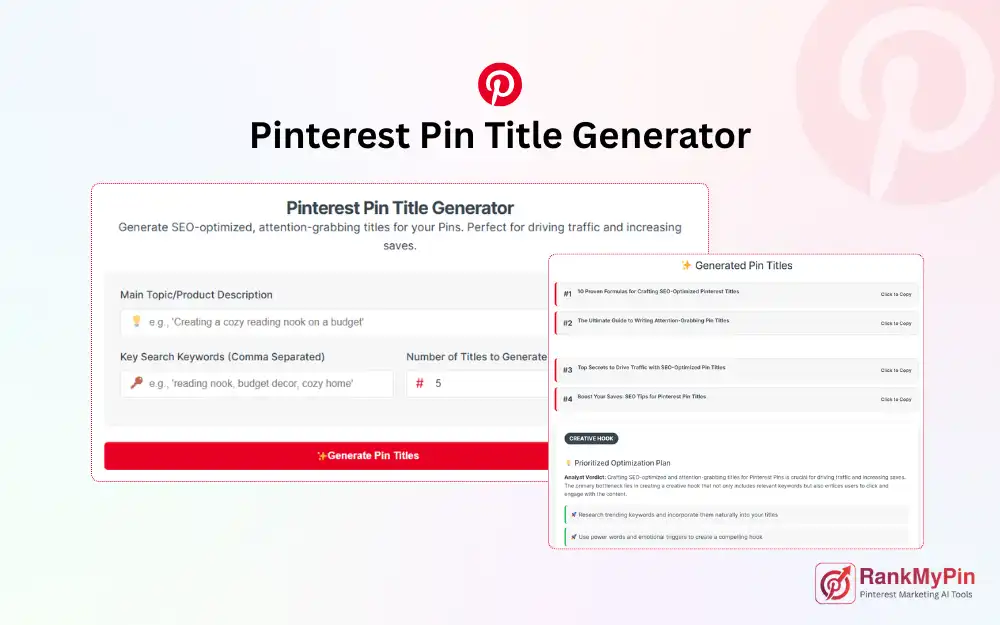
Test Different Formats, Titles, and Visuals
A/B test your designs. Does a Question headline work better than a Statement? Does a video pin drive more saves than a static image? Let the data dictate your strategy.
Frequently Asked Questions (Pinterest SEO Best Practices)
How to optimize for zero-click searches in 2026?
To optimize for zero-click searches, design Infographic Pins or Step-by-Step carousels that answer the user’s question directly on the image itself. While this doesn’t yield an immediate click, it generates massive Saves, which signals high quality to the algorithm, boosting the visibility of your other traffic-driving pins.
How to make Pinterest go viral?
To make a Pin go viral, you need to trigger the Velocity Algorithm. This requires a perfect storm: a high-trending topic (Seasonal), a visually arresting vertical image (2:3 ratio), and an immediate burst of engagement (Saves) within the first 2 hours of publishing.
What trends are coming back in 2026?
According to trend data, Nostalgic Comfort and Analog Hobbies are making a huge comeback in 2026. Users are searching for scrapbooking, film photography, and handwritten letters. Additionally, Maximalist Decor is returning, replacing the Sad Beige minimalist trend of previous years.
Is Lemon8 better than Pinterest?
Lemon8 is different, not necessarily better. Lemon8 is a Lifestyle App focused on creators and community influencers (similar to Instagram/TikTok). Pinterest is a Search Engine focused on ideas and planning. For long-term traffic and evergreen SEO results, Pinterest is superior.
Conclusion
Pinterest SEO Best Practices in 2026 are not about finding a hack to go viral overnight. They are about building a robust, technical foundation that signals Trust, Relevance, and Authority to the algorithm.
By following these 11 strategies, from treating your profile like a sitemap to engineering your visuals for the AI eye, you transform Pinterest from a passive social channel into an active, compounding traffic engine.
Ready to start? Pick one practice from this list today, perhaps optimizing your board descriptions or auditing your keywords, and execute it. The best time to start building your traffic asset was yesterday. The second-best time is now.
Disclaimer: Pinterest does not publish its full ranking algorithm. Recommendations in this guide are based on documented features, platform guidance, and long-term observed behavior.